
The Number of Meals You Eat Is a Logistics Decision
Six small meals was supposed to keep the metabolism stoked. The studies that measured energy expenditure directly never found it. What the meal count does change is smaller than that, and more useful.
 By Matt McCabeSeptember 23, 20267 min read/ Diet Theory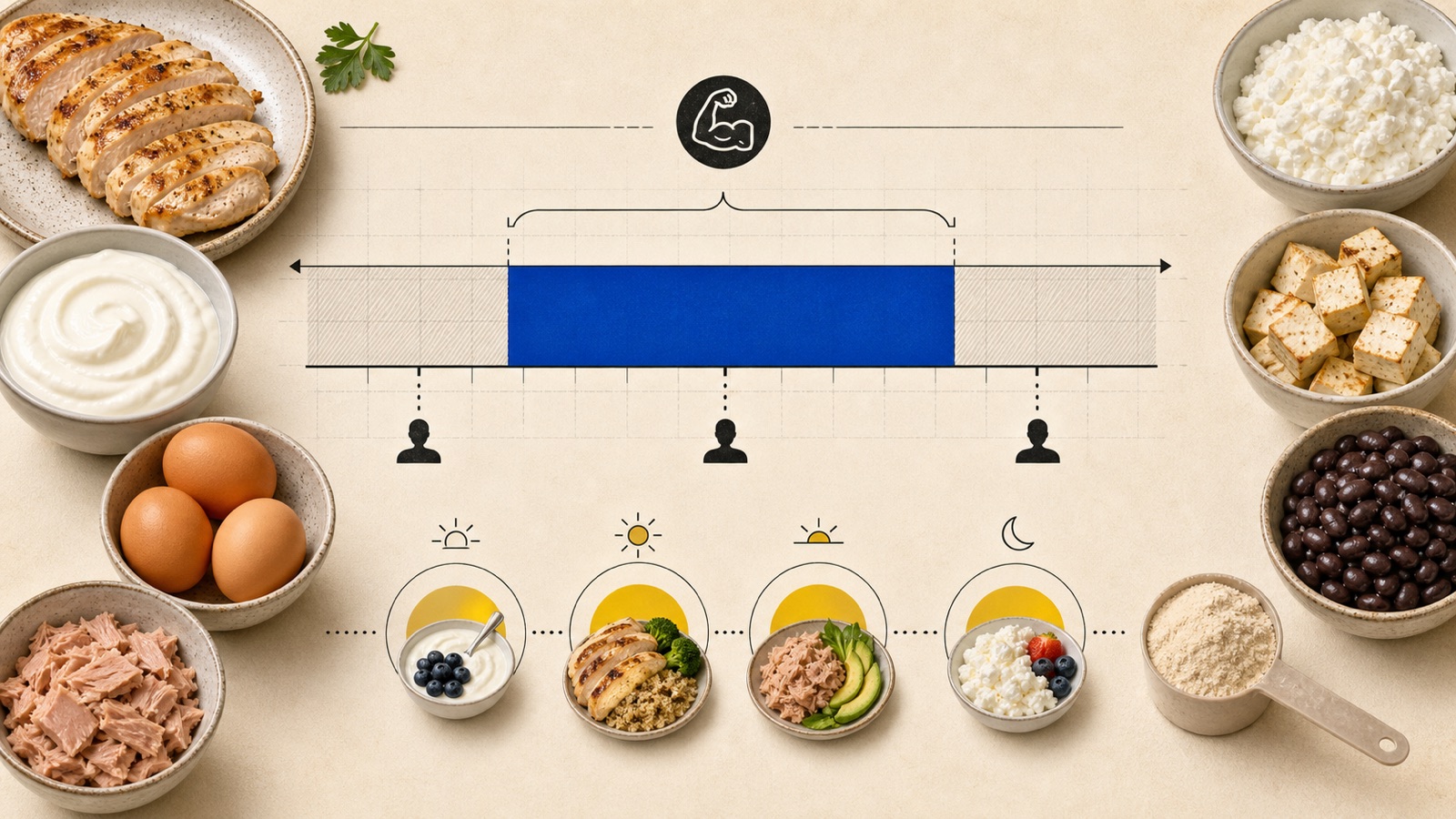
Somewhere in your first week of tracking, someone tells you to eat six small meals a day. Keep the metabolism stoked. Never let it drop. Someone else tells you to eat twice, skip breakfast, and stop grazing.
Both camps talk as though the meal count is doing the work. It mostly is not. This is one of the older questions in nutrition research and one of the better settled ones, which makes it worth knowing exactly which part of the claim is wrong and which smaller part is real.
Where the six-meal rule came from
It started with two real observations that got read too generously.
The first was epidemiological. Survey studies kept finding that people who ate more often weighed less. Bellisle, McDevitt and Prentice reviewed that literature in 1997 and found that plenty of studies showed no relationship at all, while the ones that did show a relationship pointed the same way. Their read on it was blunt: the evidence is at best very weak and almost certainly an artifact. People change how they eat after they gain weight, and dietary under-reporting invalidates some of the studies outright.
The second was the thermic effect of food, the energy your body spends digesting what you eat. It runs at roughly a tenth of what you take in. If digestion costs energy, the reasoning went, then more digestive events should cost more energy. That is an arithmetic error. The cost scales with how much food goes in, not with how many times you sit down. Split 2,400 calories six ways or three ways and the digestive bill is the same either way.
Rules like this one tend to survive because they feel like structure. That is the same reason most diet rules outlive their evidence: being easy to follow and being correct are different qualities, and only one of them gets tested.
What happens when you control the calories
The mechanism got tested properly, and it did not hold up. Bellisle and colleagues went through the possible metabolic explanations one at a time. Some short-term studies did find a higher thermic effect when the same energy load was split into several small meals, but others contradicted it and most found nothing. The studies that measured total 24-hour energy expenditure using whole-body calorimetry and doubly labeled water, which are the methods that settle this kind of question, found no difference between nibbling and gorging. With one exception, they found no evidence that weight loss on a reduced-calorie diet changed with meal frequency either.
The body-composition question got its own answer later. Schoenfeld, Aragon and Krieger pooled 15 studies in 2015 and initially found what the folklore predicted: higher feeding frequency was associated with more fat lost and more fat-free mass kept. Then they ran a sensitivity analysis and the whole effect turned out to be the product of a single study. Their own conclusion is the one to take: the finding needs to be interpreted with circumspection.
Be precise about what that means. It is not proof that frequency does nothing. It is that the apparent benefit rested on one dataset and did not survive being poked, which is a good reason to stop building a schedule around it.
The part your meal count does change
Protein is the exception, and it is the reason this question is worth asking at all.
In 2013, Areta and colleagues gave 24 trained men 80 g of whey across 12 hours of recovery from resistance exercise, in three patterns: 10 g every 90 minutes, 20 g every 3 hours, or 40 g every 6 hours. Every pattern raised muscle protein synthesis above rest. The 20 g every 3 hours pattern beat both of the others by 31 to 48 percent. Same protein, same day, same training session, different result.
The ISSN position stand on protein and exercise lands in the same place. It puts a serving at roughly 0.25 g of high-quality protein per kg of body weight, or 20 to 40 g in absolute terms, and says those doses should ideally be evenly distributed every 3 to 4 hours across the day.
Work that backwards and you get three to five eating occasions. Not six, not two. Two things to hold alongside it: this applies to protein specifically rather than to total calories, and muscle protein synthesis measured over 12 hours is a short-term proxy rather than muscle you can see months later.
It still changes something practical. Hitting your protein target is much easier across four moderate servings than across two big ones, because a single sitting has a ceiling that has nothing to do with physiology and everything to do with appetite. If you are regularly finishing the day short, the fix is usually distribution rather than a larger evening catch-up.
Grazing is not automatically more comfortable
The other half of the six-meal pitch is that it keeps hunger down. That one got a direct test recently.
The FRESH trial put 50 healthy adults through two 21-day periods, one eating three times a day and one eating six, in random order with a two-week washout. Food choices and total energy were identical in both arms. On the last day of each period, participants sat through a seven-hour clinic visit with hourly blood draws and appetite ratings every half hour.
Eating six times produced smaller swings in ghrelin and peptide YY than eating three times, and the same flattening showed up in self-reported hunger, desire to eat and fullness. The authors read that as blunted satiety and less effective appetite regulation.
Take it for what it is. One trial, appetite measured across a single clinic day, in adults who were not dieting. It is not evidence that three meals makes you leaner. What it does undercut is the assumption that eating more often automatically keeps you more comfortable. Some people genuinely do feel better grazing. That is a preference worth testing on yourself, not a rule worth inheriting.
How to pick your number
Start from the day you actually have rather than the one on the plan.
Three to five eating occasions covers everything the protein research supports, and anywhere inside that band is fine. Pick the count that survives your work schedule, your commute and your training time. Aim for something in the region of 0.25 g/kg of protein at each one, and the 3-to-4-hour spacing falls out on its own without you having to manage it.
Your total intake is the thing worth getting roughly right first. The macro calculator gives you a starting point to adjust from once you see how a few weeks actually go. And on a day with a hard session in it, what changes is where the carbs sit, not how many times you eat.
Meal count is one of those variables that feels productive because it is visible and countable. That is worth being suspicious of, for the same reason food quality rules get confused with performance: the parts of a diet that are easy to audit are not reliably the parts that decide the outcome.
The short version
Meal frequency does not change your metabolic rate. The calorimetry studies looked directly for that effect and did not find it, and the body-composition meta-analysis that seemed to find one lost it under sensitivity analysis. Six meals is not a metabolic strategy.
What the count does change is how well you spread protein, and there the evidence points at three to five servings rather than either extreme. Pick a number in that range that fits the week you actually live, put a real serving of protein in each slot, and stop treating the number itself as the intervention.
For information and education, not medical advice. If you have a health condition, are pregnant, or take medication that interacts with diet, talk to a clinician before making changes.
End of note
Subscribe
Get the next Field Note by email
A short email when a new article or recipe ships. No spam, no upsell, unsubscribe in one click.