
Carbs Around Workouts: When Timing Actually Matters
Carb timing earns real attention for endurance work, two-a-day training, and fasted sessions. For everyone else, hitting your daily totals does nearly all of the work.
 By Matt McCabeMarch 17, 2026 · Updated July 7, 20267 min read/ Programming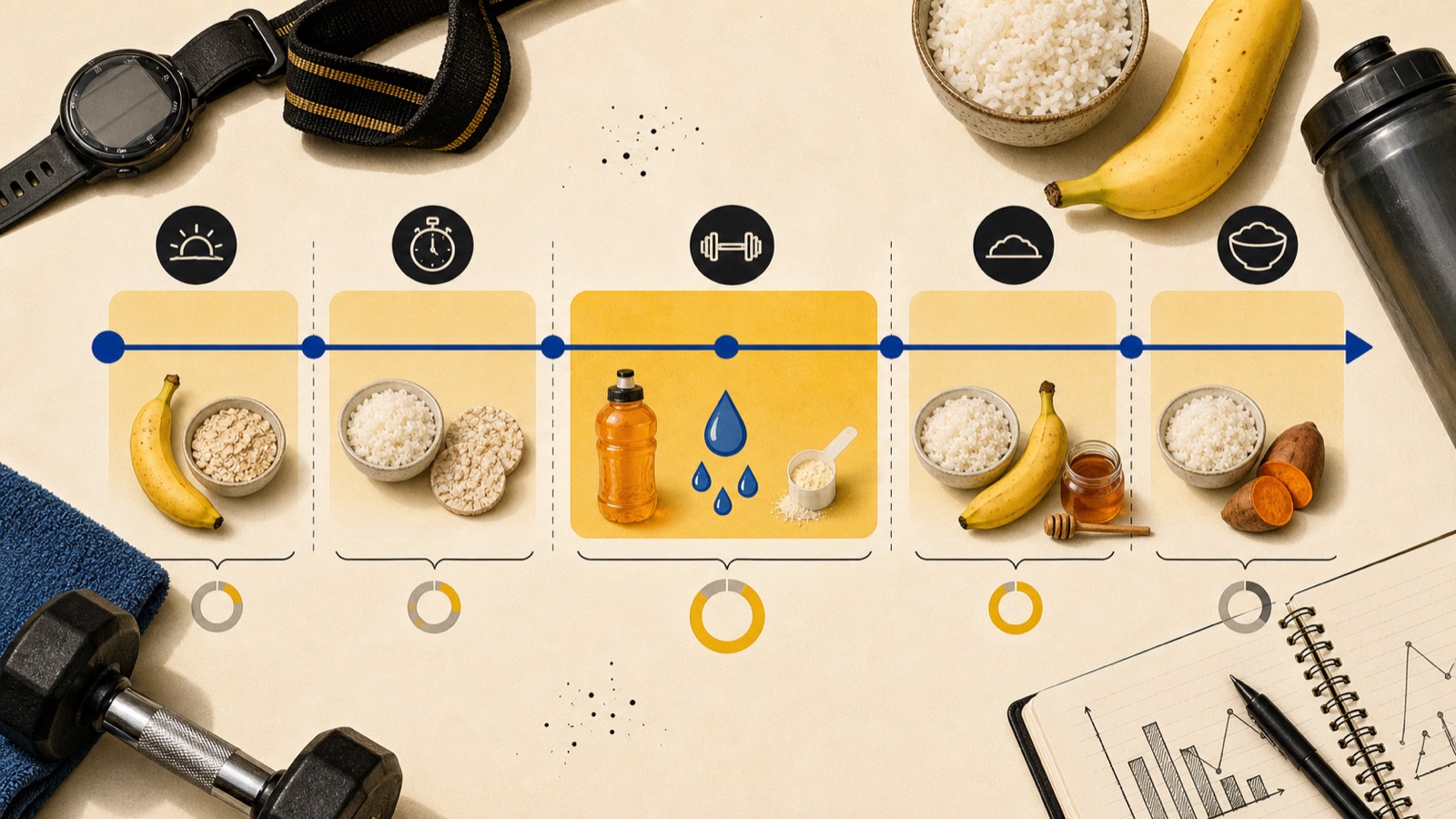
Two stories about carb timing run side by side online. One treats the 30 minutes before training as a critical anabolic window. The other shrugs and tells you to just hit your daily totals. The honest answer is closer to the second, with a small but real exception for a few specific scenarios.
What carbs are doing during a workout
During moderate-to-hard exercise, working muscle preferentially burns glycogen, the body's stored form of carbohydrate. You walk in with whatever glycogen you had and walk out with less. A full mixed meal eaten 20 minutes before training won't fully digest by your first set, so pre-workout carbs aren't really the energy source for the first part of the session. Fast carbs can still help in specific cases (fasted training, long sessions, when stomach tolerance is high). What pre-workout carbs do is keep glycogen topped up, support stable blood sugar during the session, and reduce late-workout drop-off.
When carb timing genuinely matters
The ISSN's nutrient timing position stand (Kerksick et al., 2017) and the broader review literature (Aragon and Schoenfeld, 2013) line up on a few cases:
- Long sessions, 90 minutes or more. Endurance work depletes glycogen meaningfully. Carbs before and during the session help measurably.
- Two-a-day training. The window between sessions is when glycogen replenishment matters most. Eating carbs in that window beats spreading them out evenly.
- Training fasted in the morning. If your last meal was 12 hours ago and you're about to deadlift, a small amount of fast-digesting carbs 30 to 60 minutes before measurably improves the session.
- High-frequency, high-volume athletes. If you're training daily at high intensity, distribution around sessions matters more than it does for a hobbyist lifter.
Carbs when you train twice in one day
The two-a-day case earns more than a bullet, because it is where timing does real work. When you run in the morning and lift at night, or stack two hard efforts a few hours apart, the gap between them is the part to get right. That window is when your body is fastest at refilling glycogen, and walking into the second session low is what makes it feel flat.
The research on repeated same-day efforts is fairly specific. To restore glycogen quickly between sessions, take a real dose of carbohydrate soon after the first one rather than waiting for your next normal meal (Alghannam and colleagues, 2018). If the two sessions sit close together and you are short on carbs, adding some protein to that snack helps. If they are further apart, a normal mixed meal in between covers it.
This is the same idea as carbohydrate periodization, matching fuel to the work a given day asks for (Impey and colleagues, 2018), and the same logic behind setting different macros for rest, easy, and hard days. If you train this way often, the order of your run and lift and how you use the gap between them matter as much as the totals. The same pattern scales up for endurance events: a Hyrox or a long race asks for a deliberate carb plan in the day before and morning of, not a gel at the start line.
When timing is largely noise
For most adults doing 45 to 75 minutes of lifting, fed within a few hours of training, the specific timing of carbs around the session doesn't move outcomes much. Total daily carbs, total daily protein, and training quality dominate. If you are not sure what your daily carb number should be, the macro calculator gives a reasonable starting point to adjust from, not an exact prescription.
This is the strongest version of "just hit your totals." Hit protein. Hit calories. Train hard. The timing layer adds maybe 5% on top of that, and only if the first 95% is in place.
Hitting your daily totals does most of the work. Carb timing is the last small layer, and it matters mostly for endurance athletes, two-a-day training, and fasted lifters.
The meal that matters more than pre-workout
If you only get one meal right around training, make it the meal afterward, not before. Three reasons:
- You just broke down muscle tissue. The next several hours are when repair gets started.
- Your glycogen tank is partially empty. Refilling it preps you for tomorrow.
- Insulin sensitivity is elevated right after training, so your body is unusually good at moving carbs into muscle.
The "anabolic window" doesn't slam shut at 30 minutes. Aragon and Schoenfeld's 2013 review put the practical window closer to several hours. But it does need to happen, and it should be substantial. Aim for roughly 30 to 50g of protein and a real dose of carbs (60 to 100g) within 2 to 3 hours of finishing.
Practical timing, in one paragraph
If you train fasted, eat some easy-to-digest carbs within an hour of waking, before the session. If you train in the afternoon or evening, eat a normal meal with at least 40g of carbs about 2 to 3 hours out. Within 2 hours of finishing any session, eat a real meal with substantial protein and carbs. Outside of that, place the rest of your carbs anywhere that fits your day.
"Fast" vs "slow" carbs
For pre-workout specifically, faster-digesting carbs (white rice, oats, banana, sports drink) tend to be better. You want them available, not still digesting when you start working. Post-workout: most carb sources work. Outside training, mix it up. The "always eat slow carbs" rule is a leftover from the low-fat-diet era and doesn't carry the weight it used to.
The simple version
Carb timing matters in a few specific cases (endurance, two-a-day, fasted training) and is largely noise in the rest. If you train fasted, eat carbs before. If you trained hard, eat a real meal after. Place the rest of the carbs wherever fits your day. Don't burn time optimizing the last 5% before you've nailed the first 95%.
For information and education, not medical advice. If you have a health condition, are pregnant, or take medication that interacts with diet, talk to a clinician before making changes.
End of note
Subscribe
Get the next Field Note by email
A short email when a new article or recipe ships. No spam, no upsell, unsubscribe in one click.