
Where Fad Diets Fail
Keto, juice cleanses, carnivore, 75 Hard. The marketing rotates, the outcomes line up surprisingly well. A look at the pattern and what the research suggests works better.
 By Matt McCabeMay 19, 20268 min read/ Diet Theory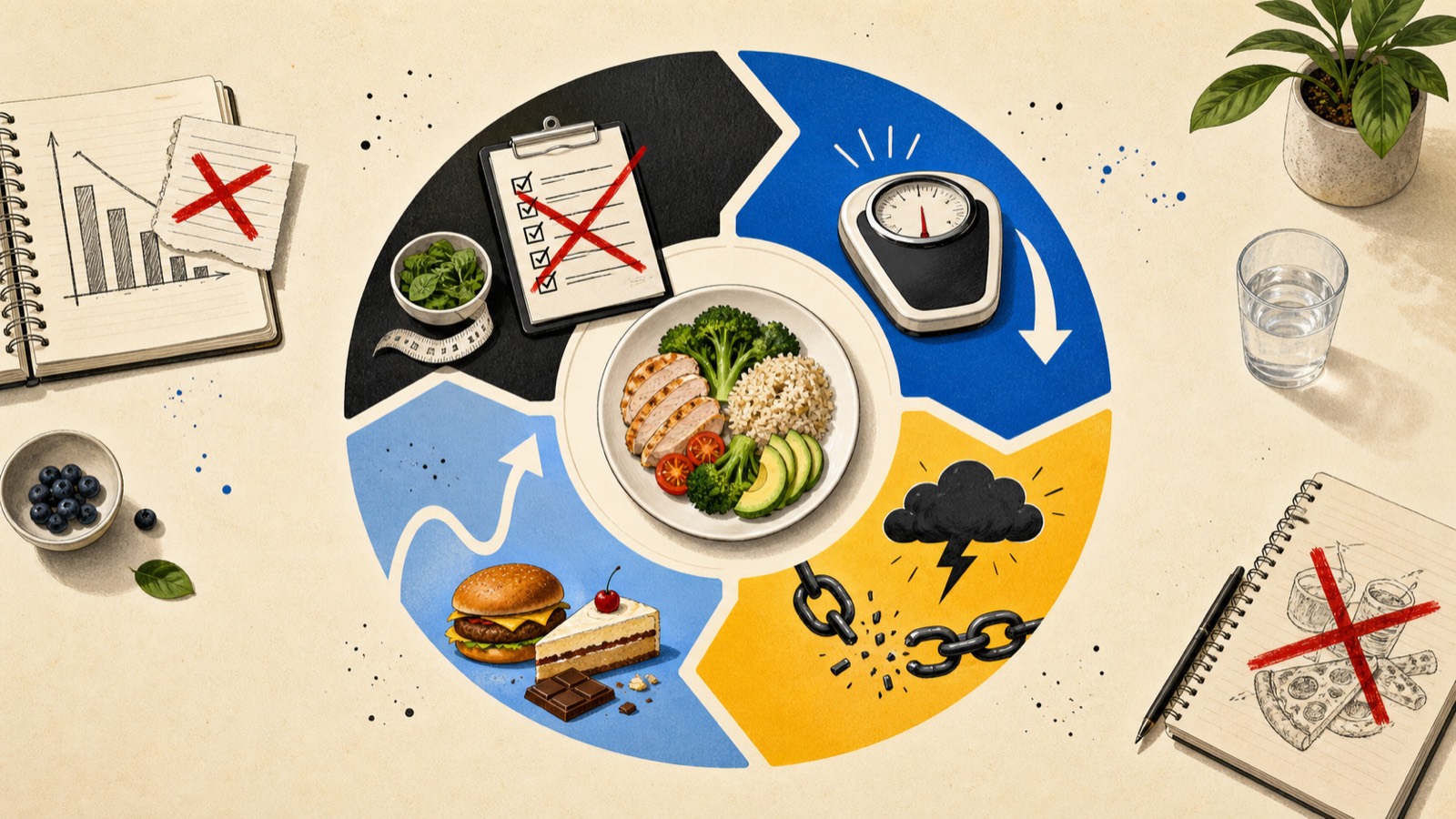
Every few years a new diet shows up wearing a fresh outfit. The founder has a new haircut. The hashtag is shorter. The actual rules, and the eventual outcome, look familiar. Drop a major macronutrient or a long list of foods, watch the scale move, declare victory, regain it within a year, blame yourself.
It's tempting to make this a story about willpower. It usually isn't. The trial data on aggressive dietary restriction tells a more consistent story than the marketing suggests.
Most diet trends sell the rule as the active ingredient. The active ingredient is almost always the calorie reduction the rule produces.
The pattern, in four steps
Whether the trend is keto, paleo, carnivore, juice cleanses, "no white food," 75 Hard, or the next acronym, the shape tends to look the same.
Step 1. A simple rule
"No carbs." "No sugar." "Only meat." "Eat in a six-hour window." The rule does real work, but the work is mostly removing calories. Cutting out a major food category often reduces intake without much deliberate tracking. The scale moves. The rule gets the credit.
Step 2. Fast early results
The first two or three weeks of any major dietary change look great. A meaningful share of the initial drop is water and glycogen, especially when carbs go down (the body stores roughly 3g of water per gram of stored carbohydrate). That's not fat loss. It's loss on the scale. Most of the marketing screenshots are taken here.
Step 3. Adherence breaks down
Around week 4 to 8, regular life shows up. A wedding. A flight. A friend's birthday. A bad night of sleep that makes the carb-free smoothie feel like a punishment. The rules don't bend with circumstances, so something has to give.
Step 4. Regain, and the shame that follows
The framing is often binary. You're either doing it perfectly or you've failed. The moment one rule slips, the rest tend to follow. The pounds come back. The diet industry has trained people to blame themselves rather than the framework. So they wait six months and try a different version.
What the trials actually show
Direct head-to-head trials suggest that when calories are matched, the specific dietary template usually matters less than the adherence to it. The 12-month DIETFITS trial (Gardner et al., 2018) randomized 609 adults to a healthy low-fat or healthy low-carb diet. Average weight loss was similar in both groups (around 5 to 6 kg) with substantial individual variation. The diet you can stick to wins.
Time-restricted eating gets a lot of attention. The TREAT trial (Lowe et al., 2020) compared a 16:8 eating window to a normal eating schedule for 12 weeks. The intervention group lost about a kilogram more, but the trial also raised a lean-mass caution, so fasting windows shouldn't be treated as a substitute for adequate protein and resistance training. Compressing eating windows can help intake control for some people. It isn't magic, and it can cost muscle if protein gets short.
Why aggressive cuts often backfire
After substantial weight loss, several things change. Hunger hormones adjust in ways that favor regain. In the Sumithran et al. (2011) NEJM paper, ghrelin and other appetite signals stayed shifted toward eating more a year after a structured loss program. Metabolic adaptation (a reduction in calorie burn beyond what bodyweight loss alone would predict) shows up in long-term work like Fothergill et al., 2016.
Translation: aggressive deficits without a plan for the back half tend to make the diet harder over time, not easier. Knowing this in advance helps you design something more durable than the first six weeks.
What tends to work better
- Know your numbers. A reasonable calorie target paired with a protein floor. The free macro calculator gives a starting estimate.
- Hit protein consistently. The research on energy-restricted diets is clear that higher protein helps preserve lean mass and satiety (Helms et al., 2014; Jäger et al., 2017).
- Pick a deficit you can sustain. 0.5 to 1.0% of bodyweight per week is a sane starting range. More is usually a problem.
- Build meals you'd cook again. See the recipe archive for examples. If you don't want to eat it twice, it isn't really part of the plan.
- Plan the exit. Diet breaks and a deliberate maintenance phase (Byrne et al., 2018, MATADOR) tend to make the long run easier.
The simple version
Most diet trends produce real short-term results because they accidentally cut calories. They struggle long-term because the rules don't bend with life and the back half of the plan was never designed. A boring approach (reasonable deficit, high protein, sustainable food choices, planned maintenance) tends to outperform any specific food rule across a full year.
For information and education, not medical advice. If you have a health condition, are pregnant, or take medication that interacts with diet, talk to a clinician before making changes.
End of note
Subscribe
Get the next Field Note by email
A short email when a new article or recipe ships. No spam, no upsell, unsubscribe in one click.