
What to Eat When You Miss Your Protein Target
It's 9pm. You're 40g short. Four ways to close the gap that don't require cooking another full meal.
 By Matt McCabeFebruary 17, 2026 · Updated August 4, 20266 min read/ Lifestyle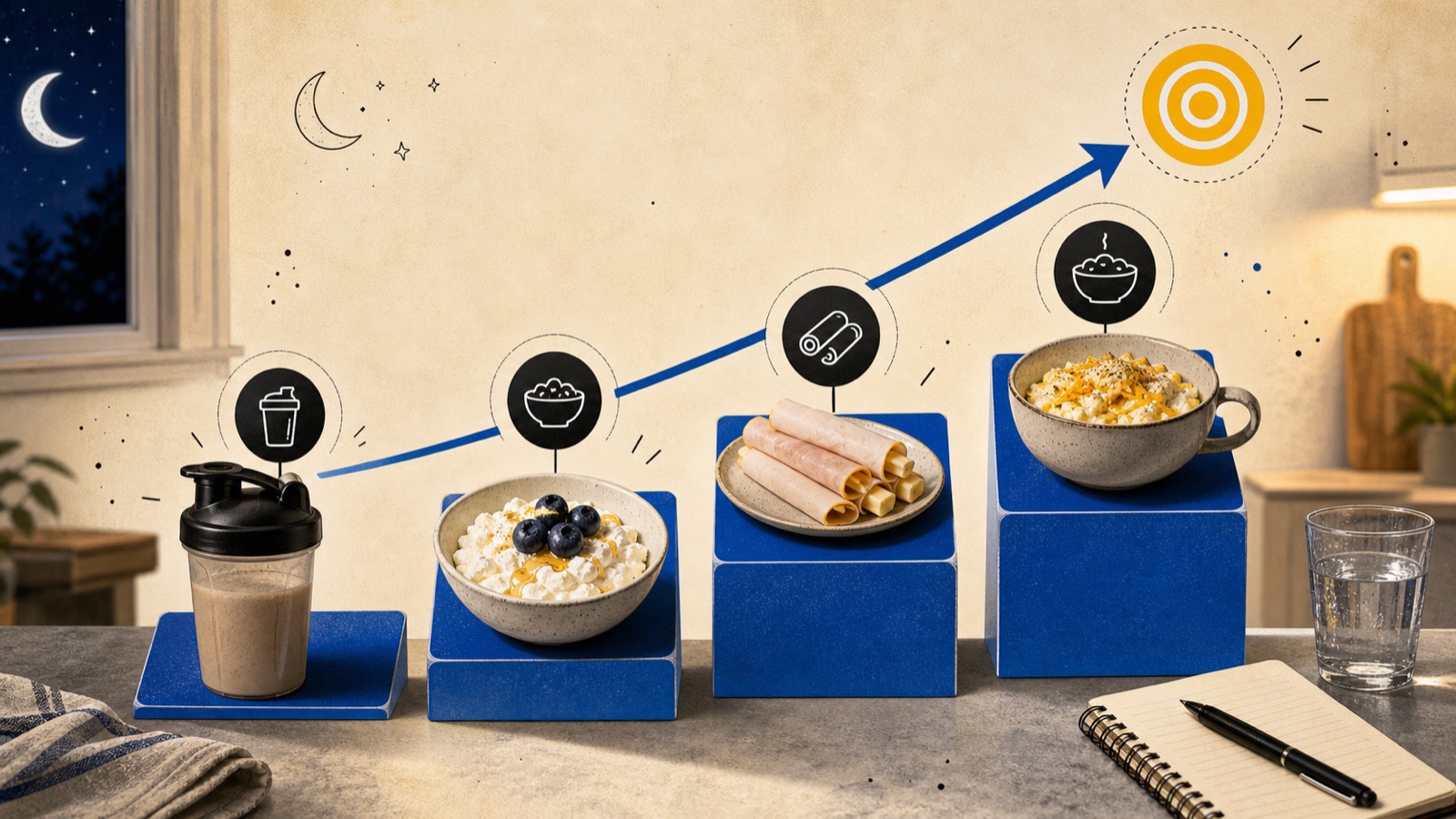
It's 9pm. You've done the math and you're 40 grams of protein short. You're tired, you don't want to cook another meal, and you're already a little full. Engineering a third chicken breast at this hour feels like punishment.
You don't need a new diet. You need a small playbook for the 9pm shortfall. Four options, in order of how much they ask of you. Pick whichever one matches your energy level. None of them require cooking anything you weren't already planning to eat.
Option 1: the shake (5 minutes, zero brainpower)
A scoop of whey or a whey-casein blend in water or milk closes a 25 to 30g gap in about 90 seconds. If you're 40g short, two scoops in water gets you roughly 45 to 50g of protein for about 220 to 260 calories. Milk adds more. Drink it, brush your teeth, go to bed.
This is the move when energy and willpower are both at zero. It works. No one should feel guilty about closing a day with a shake. The instinct that a powder is somehow less legitimate than a chicken breast is the same instinct that quietly separates clean eating from eating for performance. Your muscle still gets the amino acids.
Option 2: the cottage cheese or Greek yogurt bowl (5 minutes)
A cup of cottage cheese (25g) or non-fat Greek yogurt (22g) plus a scoop of protein powder gets you to 45 to 50g in a single bowl. Add berries, a drizzle of honey, or a few crushed nuts and it becomes dessert that happens to hit the number.
Casein-rich dairy (cottage cheese, Greek yogurt) digests slowly overnight, which is one reason pre-sleep protein has been studied directly. Trained men given 40g of casein before bed digested and absorbed it through the night, which lifted whole-body protein synthesis and pushed net protein balance from negative to positive (Res et al., 2012). Muscle protein synthesis itself came out around 22 percent higher, though that particular comparison sat right on the edge of significance. A 12-week training study later found modest but real benefits for lean mass when protein was taken pre-bed (Snijders et al., 2015). Not a miracle. Useful when it lines up.
Option 3: deli roll-ups (3 minutes)
4 oz of deli turkey or roast beef (~25g protein) rolled up with a slice of cheese (~7g). Add a pickle if you're feeling ambitious.
This is the move when you don't want anything sweet, don't want anything liquid, and don't want to dirty a bowl. Hits the number, zero cleanup.
Option 4: a small hot snack (10 minutes)
If you have a little energy and want something that feels like an actual meal: 2 eggs scrambled with 4 egg whites (about 30g protein), a slice of toast with peanut butter, a glass of milk. That's roughly 40 to 45g of protein, with the calories depending mostly on the toast, the peanut butter, and which milk you pour.
Or: microwave 4 oz of pre-cooked rotisserie chicken with a dollop of Greek yogurt and hot sauce, scoop it into a tortilla. 30g of protein in 4 minutes.
Missing protein isn't a moral failure. It's a math problem with four possible solutions, none of which takes more than ten minutes.
Can your body actually use 40 grams at once?
This is the objection that stops people from taking the shake. Somewhere along the way the idea took hold that the body caps out around 20 to 30 grams per sitting and anything above that is wasted, burned off for energy or sent down the drain. If that were true, a 50g bowl at 9pm would be half theater.
It does not hold up in the form it usually gets repeated. The 20 to 25 gram figure came from studies that fed fast-digesting whey on its own, with no other macronutrients alongside it, and watched muscle protein synthesis over the next few hours. Schoenfeld and Aragon reviewed that literature and argued the real ceiling sits higher once you account for slower-digesting proteins, mixed meals, and training that involves more muscle than a few sets of leg extensions (Schoenfeld and Aragon, 2018). Their working recommendation is about 0.4g per kg of bodyweight per meal across at least four meals, which for an 80kg lifter is roughly 32 grams a sitting, rising toward 0.55g per kg if you are chasing the top of the daily range.
So a 40 to 50 gram serving is not wasted. It is on the high side for one meal, and it is the same dose the pre-sleep work used. The wider point cuts the same way: a 2025 systematic review found no important effect of protein timing on lean mass when daily intake was matched between groups, with the strength findings mixed enough that daily intake still looks like the bigger lever (Casuso and Goossens, 2025). The total you hit across the day is the part worth defending. The hour you hit it in matters less than it gets credit for.
Which is the genuinely reassuring part of the 9pm shortfall. Closing it late still counts.
The pre-9pm fix: keep these four things in stock
- A tub of protein powder.
- A tub of cottage cheese or Greek yogurt.
- A package of deli protein.
- A dozen eggs.
If protein powder is already in the pantry, the fridge restock is usually modest. If it isn't, call the powder a pantry item you buy occasionally and the other three the weekly emergency kit. Combined, they let you close any reasonable protein gap in under 10 minutes. If none of them is in the house, the 9pm shortfall usually becomes a bowl of cereal, or nothing, and both leave you short. These four are the emergency subset of a weekly high-protein shopping list, and they are the four worth replacing the week you run out.
What if you're 80 grams short?
Now you're not slightly missing your target; you missed it by a lot. That's a sign your day's structure was off (too few protein meals, too much filler). Trying to recover 80g in a single 9pm move is hard on your stomach and on tomorrow's hunger.
Better: take the shake or cottage cheese bowl tonight to cover 30 to 40g, log the day honestly, and look at why protein got short. Breakfast is the usual culprit. Adding 25 to 35g there is the easiest single change.
If you are missing by that much most days, the problem may be the target rather than the day. Check what you are aiming at against where the protein research actually lands, and run your numbers through the macro calculator for a starting point to adjust from rather than an exact prescription. A target you miss by 40g every night is worth a second look.
What to do tonight
Have a 9pm protein backup before you need it. Stock the four staples. Pick the option that matches your energy. Get the protein in, get to bed, and don't make a $1,200 diet decision over a $0.50 nutrition mistake.
For information and education, not medical advice. If you have a health condition, are pregnant, or take medication that interacts with diet, talk to a clinician before making changes.
End of note
Subscribe
Get the next Field Note by email
A short email when a new article or recipe ships. No spam, no upsell, unsubscribe in one click.