
Why Carbs Are the Macro You Set Last
Protein gets a number and fat gets a range. Carbohydrate ends up as whatever is left, which is a reasonable place to start, as long as you check the remainder against the week you actually trained.
 By Matt McCabeSeptember 15, 20267 min read/ Foundations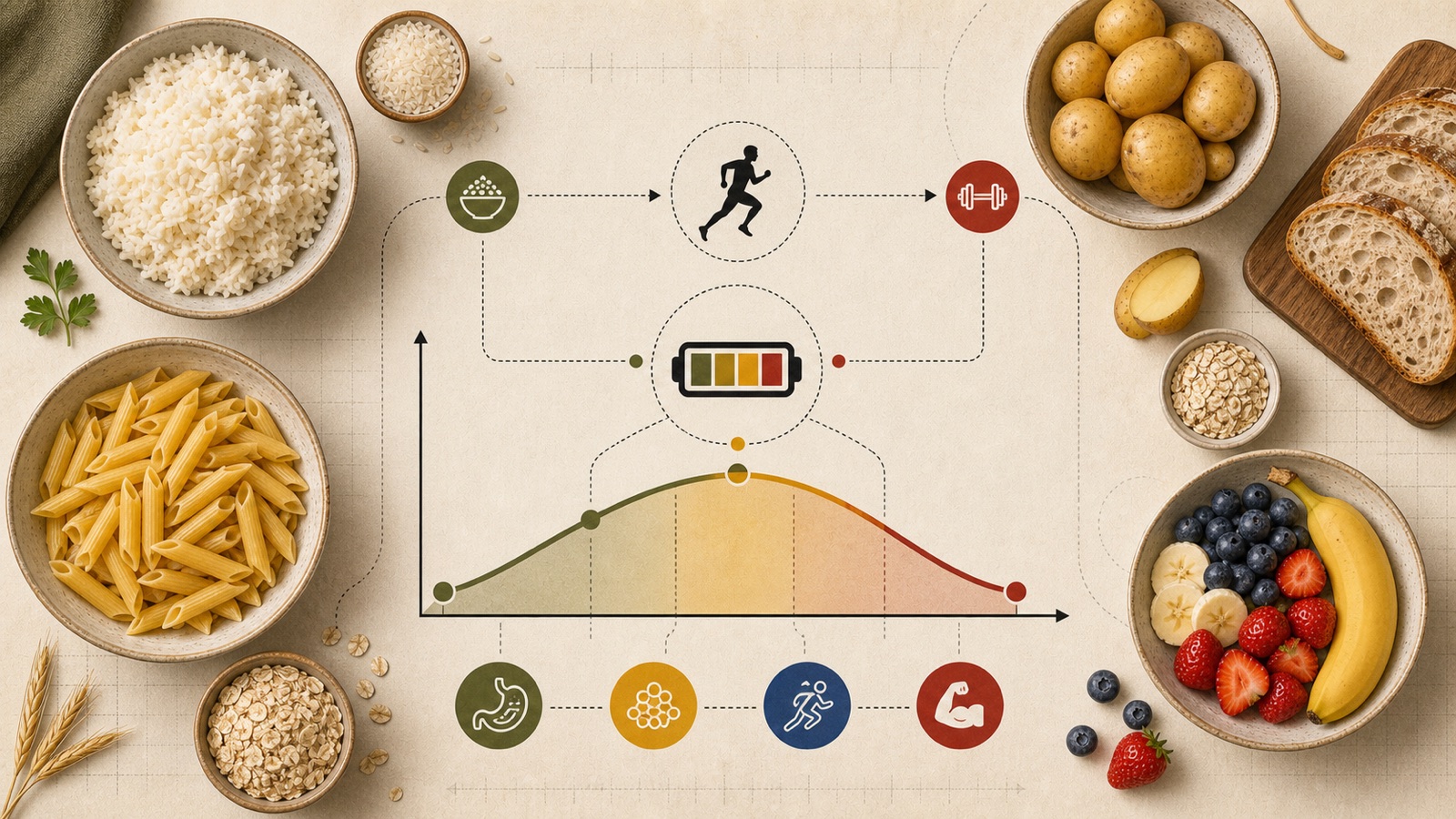
Protein gets a number. Fat gets a number. Carbohydrate usually gets whatever is left, and then people go looking for a rule to check it against. Forty percent? Two hundred grams? Half your plate?
None of those are answers, because carbohydrate is the only macro whose sensible range moves with what you did that week. Set it as a fixed percentage and it will be wrong in both directions across a training block. The question is not what share of your calories carbs should be. It is how much work you are asking them to cover.
The baseline number is not a training target
There is an official number, worth knowing mostly so you stop treating it as either a minimum or a goal. The Dietary Reference Intakes set the RDA for carbohydrate at 130 grams a day for adults, and the basis is narrow: it is the glucose the brain uses. Not the glucose a training week uses.
It is also not a physiological minimum, which is the part that gets lost. The report notes that the body can make glucose from protein and fat, so intakes below 130 grams are survivable. It is neither a floor you would fall through nor a target worth aiming at.
The report's acceptable range of 45 to 65 percent of calories is general dietary guidance, meant to inform individual planning as much as population assessment. What it does not do is say anything about fueling a training load. And a percentage is a weak instrument anyway, because 50 percent of 1,800 calories and 50 percent of 3,200 calories are different jobs. Percentages describe a diet after the fact rather than setting one.
Protein and fat go first
Carbs come last not because they matter least, but because the other two get set against something and carbohydrate does not. Protein is set against your body weight and defended hardest when calories are low, which is a number worth setting deliberately rather than backing into. Fat has a floor below which a long diet starts costing you things you would rather keep, and that floor is the part people skip. Carbohydrate absorbs whatever is left once both are met.
Helms and colleagues laid this out for natural bodybuilders preparing for competition in their review of contest preparation (2014): set bodyweight loss at roughly 0.5 to 1 percent a week, take 2.3 to 3.1 g/kg of lean body mass as protein, 15 to 30 percent of calories as fat, and let carbohydrate be the remainder.
Worth separating two things there. Their 15 to 30 percent is a recommended band, not the fat floor described above, and they are candid that the occasional competitor does better outside the ranges entirely. The population is also narrower than most people reading this. So take the order of operations, which travels, rather than the numbers, which were written for someone dieting down for a stage.
The band follows your training load
The remainder still has to land somewhere sensible, and training volume is what decides where. Kerksick and colleagues' sports nutrition review (2018) puts someone on a general fitness program at 3 to 5 g/kg a day, which they describe as roughly a normal 45 to 55 percent carbohydrate diet. Athletes doing moderate amounts of intense training, which they define concretely as two to three hours a day of intense exercise five to six times a week, are placed at 5 to 8 g/kg a day.
Note how far apart those bands sit. For an 80 kg person that is 240 to 400 grams against 400 to 640 grams. Same body, different week.
Delany and colleagues' 2025 scoping review of consensus statements found the same idea as a range: across the guidance they reviewed, carbohydrate gets periodized between 3 and 12 g/kg a day on the basis of training demands. Twelve grams per kilogram is a stage race, not a Tuesday. The width of that envelope is the finding.
What none of that gives you is one number for a normal week, and that is the honest answer rather than a dodge. The bands are indexed to load, so a week holding three hard sessions and four quiet days has no single right figure. One flat daily number is too much on the quiet days and too little on the hard ones. That is still a question of how much, and a separate one from where in the day the carbs sit, which is worth solving after this one.
What a deficit does to the number
Cutting is where carbs get squeezed, because the remainder is what shrinks. The Delany review found that guidance for athletes losing body or fat mass sat between 3 and 10 g/kg, with several documents emphasizing the lower end, 3 to 6 g/kg a day. That describes what the guidance says. It is not a rule about where you personally have to land, and the review sets no minimum.
There is probably a limit to how far down you should go, and the careful wording is the point. In natural bodybuilders preparing for competition, Helms and colleagues write that a practical carbohydrate threshold appears to exist where further reductions negatively impact performance and put one at risk for lean body mass losses. Appears to exist, and at risk. They attach no number to it, and say the point of detriment likely has to be found individually.
So when sessions start degrading there are two things to check, not one. Total energy is the obvious one, and the number to check there is what your actual maintenance turned out to be rather than what a formula predicted. Carbohydrate availability is the other, and the one that gets skipped. Helms and colleagues suggest that if training performance degrades it may prove beneficial to decrease the percentage of calories from dietary fat within their recommended ranges in favor of a greater proportion of carbohydrate. Fat moves down inside its band, not below it, and the trigger is training falling apart rather than the scale refusing to move.
Running your own number
The arithmetic is short. Take your calorie target. Subtract protein at 4 calories a gram. Subtract fat at 9. Divide what is left by 4. That is your carbohydrate number in grams.
Then sanity-check it against your body weight. An 80 kg person eating 2,600 calories with 170 g protein and 75 g fat lands at 311 g of carbohydrate, about 3.9 g/kg. Note that the 75 g of fat is a chosen intake sitting well above any floor, not the floor itself, which matters for what you do next.
Whether 3.9 g/kg is enough depends on the week it covers, and this is where session counts mislead. Four hour-long gym sessions and an easy weekend run sit comfortably inside it. Two to three hours a day of intense work five to six days a week, the load Kerksick and colleagues attach to their 5 to 8 g/kg band, does not. Six half-hour sessions and six two-hour sessions are both "six days a week", and only one reaches the upper bands.
If the number looks low against the week you are actually training, check the inputs that produced it before the number itself. Calories may be set for less training than you are doing, or fat may be parked higher than it needs to be, and above the floor there is room to move it. That does not make adjusting carbohydrate directly wrong. It makes it the second question rather than the first.
The macro calculator runs that sequence and gives you a starting point rather than a prescription. What it cannot know is how your week actually went, which is yours to adjust from once you have a few weeks of your own data.
The short version
- The 130 g RDA is built on the brain's glucose use. It is neither a physiological minimum nor a training target, and the 45 to 65 percent range says nothing about fueling training.
- Set calories, then protein, then fat, and let carbohydrate be the remainder. A practical starting method, not a ranking of importance or something you are stuck with.
- Check the remainder against training load: roughly 3 to 5 g/kg on a general fitness program, 5 to 8 g/kg at two to three hours a day of intense training five to six days a week.
- The wider periodized envelope runs 3 to 12 g/kg a day depending on demands, and guidance for losing fat mass ran 3 to 10 g/kg with emphasis on the lower end. That describes the documents, not a range you are obliged to sit in.
- In natural bodybuilders preparing for competition, a practical carbohydrate threshold appears to exist where further reductions may harm performance and increase the risk of losing lean mass. No number is attached to it, and it likely has to be found individually.
- If sessions start degrading, check total energy and carbohydrate availability together rather than picking one.
The useful reframe is that you do not really have a carb number. You have a calorie number, a protein number, a fat figure you chose, and a set of bands that say whether what fell out the bottom is in the right neighborhood for the week you just trained. When the two disagree, the training week is the honest one.
For information and education, not medical advice. If you have a health condition, are pregnant, or take medication that interacts with diet, talk to a clinician before making changes.
End of note
Subscribe
Get the next Field Note by email
A short email when a new article or recipe ships. No spam, no upsell, unsubscribe in one click.