
Pick Your Rate of Weight Loss Before You Pick Your Calories
Most diets start with a calorie number and accept whatever speed comes with it. Deciding how fast the scale should move, then setting the food to match, protects more muscle and gives you something to steer by.
 By Matt McCabeNovember 10, 20267 min read/ Programming
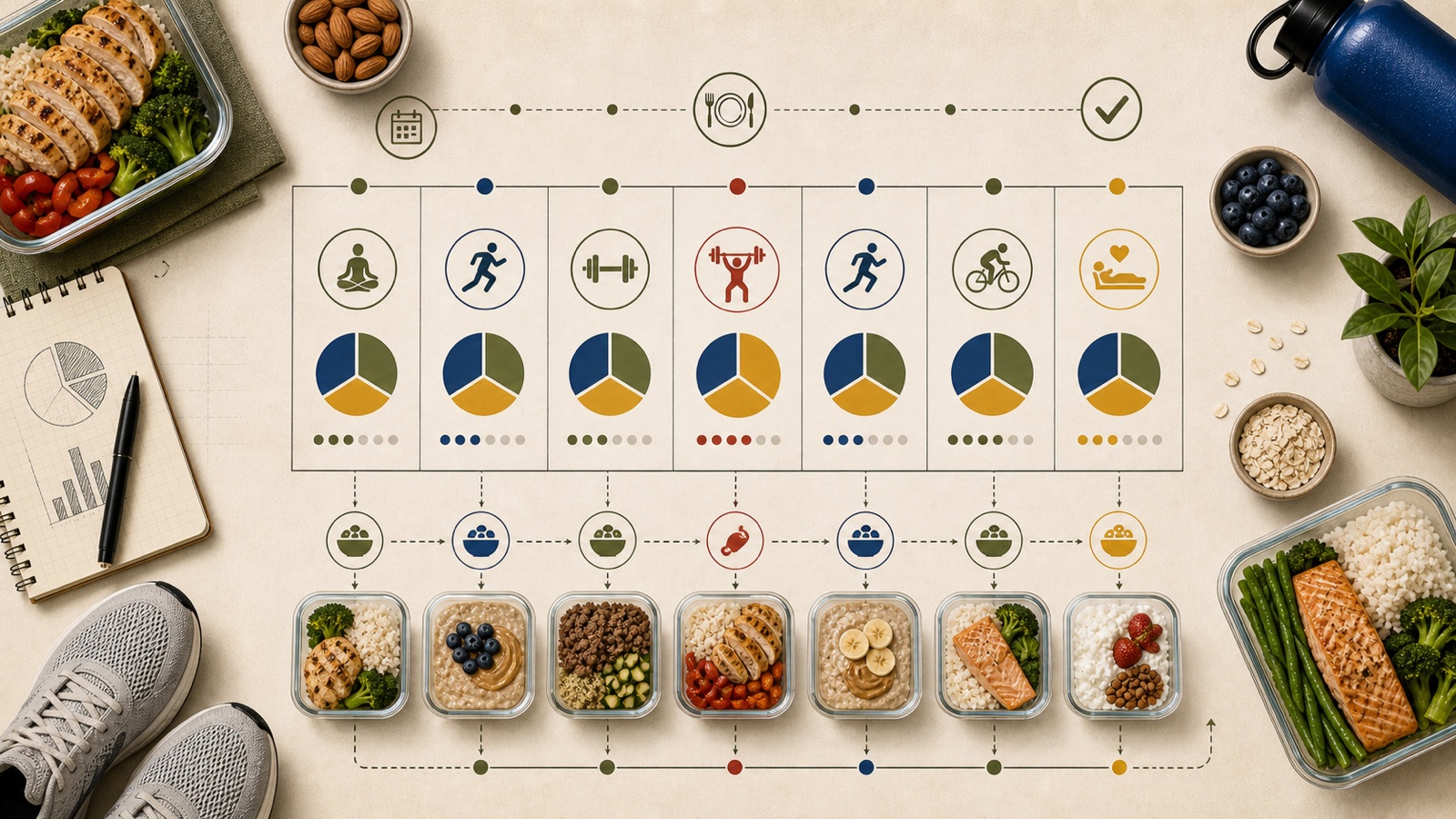
How fast should the scale be moving when you are trying to lose fat? Most people never decide. They pick a calorie number that sounds strict enough, then take whatever rate of loss shows up.
It works better the other way around. Pick the rate first, then set the calories that produce it. For most people who train, a good rate is 0.5 to 1 percent of bodyweight per week. Sit near the low end if you are already fairly lean or care about your lifts. Sit near the high end if you have more fat to lose.
Why a percentage and not a flat number
The usual advice is one to two pounds a week. That is fine as a rough guide, but it treats a 140 pound person and a 240 pound person as the same problem. Two pounds a week is 1.4 percent of the first person and 0.8 percent of the second. One of those is an aggressive diet. The other is an ordinary one.
A percentage scales with you. Half a percent to one percent works out to about 0.7 to 1.4 pounds a week at 140, 0.9 to 1.8 at 180, and 1.2 to 2.4 at 240. It also shrinks as you do, which is what you want. The same range is what Helms, Aragon and Fitschen (2014) recommended in their review of contest preparation for natural bodybuilders, a group with every reason to care about holding on to muscle while dieting.
What happened when athletes lost weight at two speeds
The cleanest test of this is a small Norwegian trial. Garthe and colleagues (2011) randomized 24 elite athletes to lose weight slowly or quickly. The slow group aimed for 0.7 percent of bodyweight per week and the fast group for 1.4 percent. Everyone lifted four times a week on top of their normal training.
Both groups ended up losing about the same share of their bodyweight, 5.6 percent in the slow group and 5.5 percent in the fast one. The slow group took about eight and a half weeks to get there on a 19 percent cut in calories. The fast group took a little over five weeks on a 30 percent cut.
Same weight lost, different weight. Fat mass fell 31 percent in the slow group against 21 percent in the fast group. Lean body mass rose 2.1 percent in the slow group and did not change in the fast one. The slow group lost more fat and added a little lean mass on the way down.
Two cautions. It is one trial with 24 people. And the fast group did not manage 1.4 percent a week in practice. They averaged about 1.0 percent, so the comparison that was actually run is closer to 0.7 against 1.0. That makes the result more useful, not less, because those are the two ends of the range most people choose between.
Bigger bodies, similar direction
Athletes are not everyone, so it is worth checking the other end. Ashtary-Larky and colleagues (2020) pooled trials in people with overweight or obesity that compared gradual and rapid weight loss where both groups lost the same total amount.
With total weight loss matched, the gradual groups lost about 1 kg (2.2 pounds) more fat and finished with a lower body fat percentage. Resting metabolic rate also held up better with gradual loss. Fat-free mass did not differ significantly between the two speeds, so this is not proof that fast dieting strips muscle from everyone. It does say that the slower route did at least as well on every measure they pooled.
Where the deficit starts to cost you
Rate of loss is just the size of your deficit showing up on the scale, so it helps to look at the deficit directly. Murphy and Koehler (2022) pooled trials of people lifting weights while in an energy deficit. Lean mass gains were impaired in a deficit, while strength gains were comparable. Their meta-regression put the point where lean mass gains stopped at a deficit of roughly 500 calories a day, and they concluded that people lifting to preserve lean mass during weight loss should avoid deficits larger than that.
On paper, 500 calories a day is about a pound a week. For a 200 pound person that is 0.5 percent. For a 140 pound person it is 0.7 percent. So that finding and the athlete trial point at the same place: the lower half of the range is where muscle is safest.
Turning a rate into a calorie number
The arithmetic is rough but good enough to start with. Multiply your target pounds per week by 500 to get a daily deficit.
- 180 pounds at 0.5 percent: 0.9 pounds a week, about 450 calories a day below maintenance.
- 180 pounds at 0.75 percent: 1.35 pounds a week, about 675 calories a day.
- 180 pounds at 1 percent: 1.8 pounds a week, about 900 calories a day.
You need a maintenance estimate to subtract from. The macro calculator gives you a starting point for that, not an exact figure, which is one more reason to steer by the rate and not by the calorie math. If you want the full setup with protein and training alongside the deficit, that is in how to set your macros for fat loss.
Look at what the top of the range asks for. A 900 calorie deficit is a lot of food to remove from someone eating 2,600. It is workable for a short stretch if you have plenty of fat to lose. It is a hard way to train.
Where to sit in the range
Go toward 0.5 percent if you are already fairly lean, if you are training for something, or if your lifts and runs matter to you during the diet. There is less stored fat to draw on and more to lose from a bad session.
Go toward 1 percent if you have a lot of fat to lose and performance is not the priority right now. The cost of a larger deficit is lower for you, and visible progress early helps you stay with it.
Whichever you pick, slow down as you get leaner. A rate that was comfortable in week two tends to get harder by week twelve. If the diet is going to run that long, a planned diet break is a better tool than pushing the deficit harder.
How to check the rate you are actually getting
Ignore the first week or two. Cutting food, and carbs especially, drops water and gut contents fast, and that early slide says little about fat. After that, weigh most mornings, average the week, and compare it with the week before. A single reading can swing by a few pounds for reasons that have nothing to do with fat.
Judge the rate over two or three weekly averages, then adjust in small steps.
- Losing faster than 1 percent a week after the first two weeks: add 100 to 200 calories a day, mostly carbs.
- Inside the range: change nothing.
- Under 0.5 percent for three weeks running: check your tracking before you cut again. Most stalls are one of a handful of fixable problems, and fewer calories is rarely the first fix.
One note on scope. This is about ordinary diet and training. If you are losing weight on medication or under a doctor's care, the right rate is a conversation to have with them.
The short version
Aim for 0.5 to 1 percent of your bodyweight per week. In the one trial that compared two speeds in athletes, the slower group lost more fat and gained a little lean mass for the same total weight lost. In people with more fat to lose, gradual loss did at least as well as rapid loss on everything that was measured. Pick a rate, set calories to match, and let two or three weeks of averages tell you if the calories were right.
If you want a maintenance estimate to start from, the calculator will give you one in a minute or two.
For information and education, not medical advice. If you have a health condition, are pregnant, or take medication that interacts with diet, talk to a clinician before making changes.
End of note
Subscribe
Get the next Field Note by email
A short email when a new article or recipe ships. No spam, no upsell, unsubscribe in one click.