
Hyrox Race Day Fueling: From the Day Before to the Start Line
The plan that gets you to the start line in good shape is mostly set the day before, not the morning of. A workable framework for the day before, the pre-race meal, caffeine, and hydration up to the gun.
 By Matt McCabeJune 9, 2026 · Updated August 24, 20267 min read/ Programming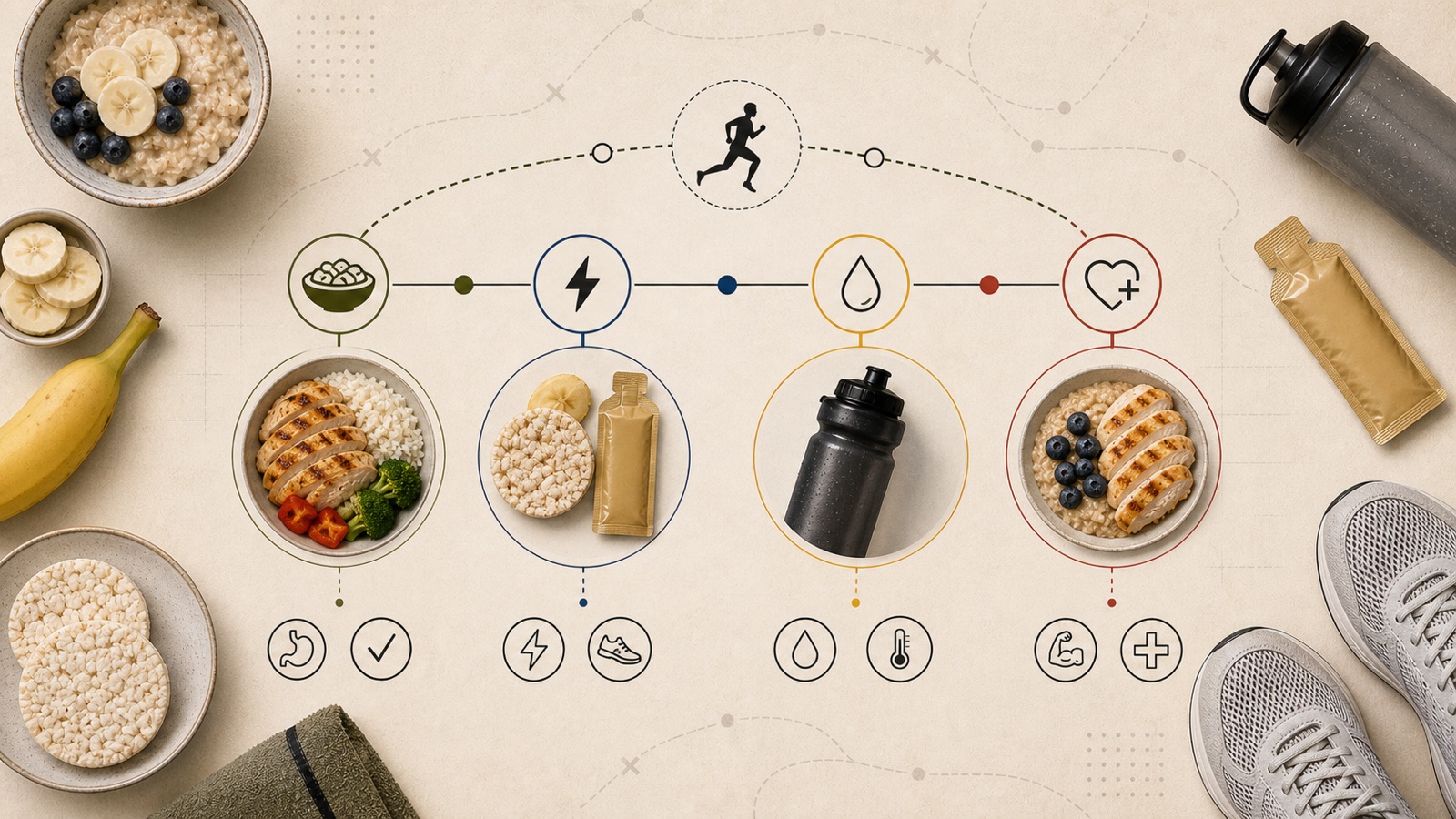
A Hyrox is about an hour of running and eight functional stations, all of it glycolytic. The plan that gets you to the start line in good shape is mostly set the day before, not the morning of.
Race day is not when you debut a new gel, a new breakfast, or a new caffeine dose. It is when you execute something you have already practiced. Here is a workable framework, from the day before through the start line.
The day before
Glycogen is the fuel that goes first in a Hyrox effort. You are not going to fat-oxidize your way through 1km repeats with sled pushes in between.
The joint position stand from the Academy of Nutrition and Dietetics, Dietitians of Canada, and the American College of Sports Medicine (Thomas, Erdman, and Burke, 2016) describes carb loading as a strategy for sustained or intermittent events lasting roughly 90 minutes or more, at intakes around 10 to 12 g of carbohydrate per kg of body weight per day for 36 to 48 hours before the event.
For most Hyrox athletes, that is more aggressive than it needs to be. A standard race lands closer to 60 to 90 minutes, and a true load is mostly worth it for longer endurance events like a half marathon, marathon, or ultra, very high training loads, or athletes who have been under-fueling in the lead-up.
Not sure which side of that line you land on? The Hyrox carb loading calculator takes your target finish time and gives you a day-by-day answer.
In practice, a useful default the day before is a high-carb, low-fiber day built around your normal hard-day targets, give or take. Plenty of carbs, normal protein, lower fat, keep the gut quiet.
What that looks like:
- Breakfast: oats, banana, honey, a small amount of protein
- Mid-morning: bagel or rice cakes with jam
- Lunch: white rice, lean protein, low-fiber vegetables
- Snack: pretzels, a piece of fruit, a sports drink
- Dinner: pasta or rice with chicken, light tomato sauce, no heavy fats or large salads
Protein stays where it usually is. Fat and fiber come down a bit to make room for the carbs and to keep tomorrow morning calm.
If you want a starting point in grams, the Hybrid Athlete Macro Calculator gives you a hard-day target. Use that as the floor for the day before. Step up from there only if you have a clear reason.
Race morning
The pre-race meal is where most athletes either nail it or pay for it through the wall ball.
The International Society of Sports Nutrition position stand on nutrient timing (Kerksick et al., 2017) supports a pre-exercise meal of 1 to 4 g of carbohydrate per kg, eaten 1 to 4 hours before the event. For a Hyrox, two to three hours out is the usual sweet spot, at the lower end of that carb range if you sit heavy.
For a 75 kg athlete eating about 2.5 hours before the gun:
- Roughly 100 to 150 g of easy carbohydrate
- 20 to 30 g of protein
- Minimal fat and fiber
Examples that fit: a large bowl of oats with banana and a scoop of whey, two slices of white toast with honey and a yogurt, or a bagel with jam and a sports drink. Boring, familiar, repeatable.
Thirty to sixty minutes before the start, top up with a small, rehearsed snack of fast carbs. A banana, a few dates, or a gel. Not a meal. A primer.
One practical note specific to Hyrox: the race does not supply in-event fuel beyond water in the Roxzone, and per HYROX competition rules any nutrition you want to use during the race must be carried from the start. If gels are part of your plan, decide before you walk into the venue how many you are carrying and where.
Caffeine, if it works for you
Caffeine is one of the most well-supported performance aids in endurance and mixed-modal sport. The IOC consensus statement on dietary supplements (Maughan et al., 2018) lists caffeine as having strong evidence for performance benefit at 3 to 6 mg per kg of body weight, ingested about 60 minutes before the event.
That is roughly 225 to 450 mg for a 75 kg athlete. A standard cup of brewed coffee is around 95 mg, so most people land in the right zone with two cups or a single pre-workout serving.
Two things matter.
First, it only works if it is rehearsed. Race day is not the morning to try a new pre-workout for the first time. Sensitivity, gut tolerance, and timing all vary by person.
Second, more is not better. The same review notes that doses above about 9 mg/kg do not improve performance further and can add side effects like elevated heart rate and gut distress that hurt rather than help on a wall ball.
Hydration up to the start line
Drinking past thirst with plain water is a real and underrated mistake. The American College of Sports Medicine position stand on exercise and fluid replacement (Sawka et al., 2007) flags dilutional hyponatremia as a risk when athletes overdrink, especially without sodium.
A reasonable approach for a normal-climate race morning:
- 500 ml of fluid with electrolytes, 2 to 3 hours before the start
- Another 200 to 300 ml in the 30 minutes before, sipped, not chugged
Hot venue, or a known heavy sweater: add sodium, not just volume. Most commercial electrolyte mixes target the 500 to 1000 mg sodium per liter range that the same ACSM position stand recommends for endurance work.
The framework, condensed
Day before: a high-carb, low-fiber day around your normal hard-day targets. Protein the same. Fat lower. Step up to a true 10 to 12 g/kg load only if the event, your training load, or your fueling history calls for it.
Race morning, 2 to 3 hours out: 1 to 2 g/kg of easy carbohydrate with a little protein. Minimal fat and fiber.
Thirty to sixty minutes out: a small carb top-up, optional caffeine at 3 to 6 mg/kg if rehearsed.
Hydration: 500 ml with electrolytes 2 to 3 hours before, another 200 to 300 ml in the 30 minutes before, sodium up if it is hot.
Bring your own in-race nutrition from the start. The race does not supply it.
Nothing here should be new. The plan is the plan you already practiced.
For training-day-by-training-day numbers, the Hybrid Athlete Macro Calculator sets your rest, easy, and hard day targets. For the broader framework on how those days fit together across a training week, see Macros for Hybrid Athletes.
For information and education, not medical advice. If you have a health condition, are pregnant, or take medication that interacts with diet, talk to a clinician before making changes.
End of note
Subscribe
Get the next Field Note by email
A short email when a new article or recipe ships. No spam, no upsell, unsubscribe in one click.