
What Are Macros, And Why They Actually Matter
The calorie line on a nutrition label tells you the budget. Macros tell you how it's spent. A plain-English look at why the spending tends to matter more than the number.
 By Matt McCabeMay 12, 20267 min read/ Foundations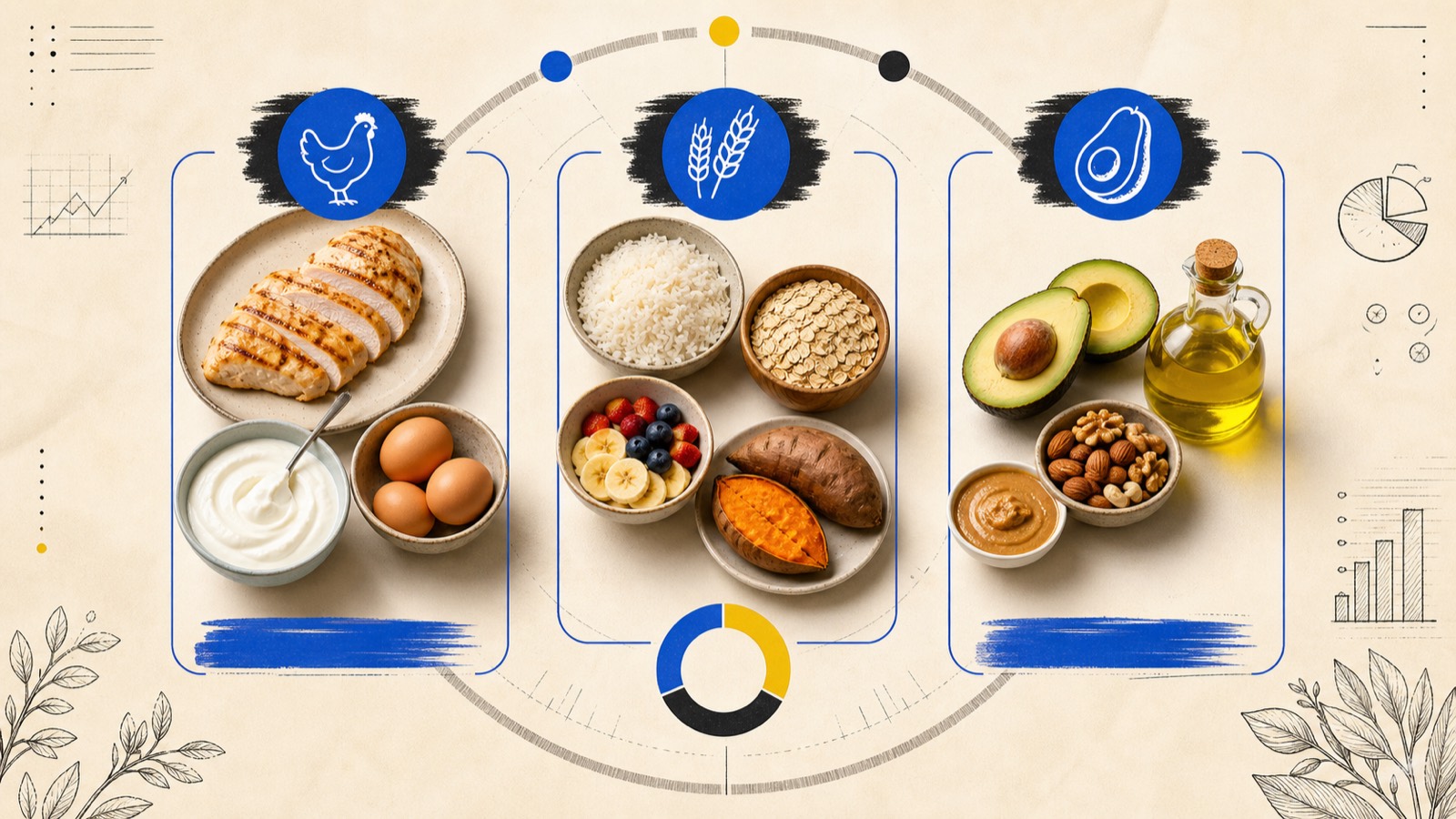
Most people who walk into nutrition coaching know one number: the calorie count on the back of a package. That number isn't wrong. It's just incomplete. It tells you the budget for the day. It says nothing about how to spend it.
The spending plan is the macros conversation. And for most goals (fat loss, muscle gain, training recovery, staying sane on a long diet) macros do a meaningful share of the work that calorie tracking alone can't.
The three macros, in plain English
Three macronutrients make up the calories in your food: protein, carbohydrates, and fat. (Alcohol is a fourth source of calories but isn't really a macro in the same sense.) Water contributes no calories. Fiber contributes less usable energy than starch or sugar, and some fermentable fibers provide a small amount of energy via gut bacteria, but it's a small contribution and most fiber does its real work elsewhere in the gut.
Protein, the structural macro
Protein is the only macro your body can't manufacture from the other two. You have to eat it. It supplies amino acids that build and repair muscle, run your immune system, and form most of the enzymes and hormones you depend on. Each gram contains about 4 calories.
The government's RDA for protein (0.8 g per kg of bodyweight per day) was set to prevent deficiency in sedentary adults. The research on trained adults points to a higher useful range: roughly 1.6 to 2.2 g per kg, or about 0.7 to 1.0 g per pound of bodyweight (Morton et al., 2018; Jäger et al., 2017). For most people who lift, that's the single biggest dietary lever for body composition.
Carbohydrates, the performance macro
Carbs get a reputation that isn't quite earned. The standard American diet is heavy on refined grains and sugar, sure. That doesn't make the macronutrient itself the problem. Carbohydrates are the body's preferred fuel for moderate-to-hard work, from a heavy squat session to a long run. Each gram is about 4 calories.
The right amount depends on what you're asking your body to do. An office worker getting 7,000 steps a day uses less than a strength athlete training six days a week. Scale carbs to the workload.
Fat, the hormonal macro
Fat is the most calorie-dense of the three at about 9 calories per gram. Eat too little for too long and hormones, sleep, and recovery tend to suffer. Eat too much without paying attention and the calories add up quickly, because fat is less filling per gram than protein.
Sports-nutrition reviews generally keep fat in a range of about 20 to 35% of total calories, or roughly 0.5 to 1.0 g per kg of bodyweight per day while dieting (ISSN review update, Kerksick et al., 2018). Going much lower than that for long stretches rarely helps.
Calories are the budget. Macros are how you spend it. You can hit the same calorie target two different ways and end up in two very different places.
Why this matters more than the calorie total alone
Picture two people at 2,200 calories a day. Person A: 180g protein, 220g carbs, 60g fat. Person B: 60g protein, 300g carbs, 80g fat. Same calorie line on a spreadsheet. Two meaningfully different outcomes six months in.
Person A will tend to hold more muscle, train better, recover faster, and stay full enough to actually keep eating that way. Person B is more likely to lose muscle along with whatever fat they drop, feel hungry more often, and end up with a body composition they didn't ask for.
That's the case for tracking macros instead of (or alongside) just calories. Calories treat food as interchangeable fuel. Macros treat it as a set of signals about what to build, what to repair, what to store.
How to actually start
- Run your numbers. Use the free macro calculator for a starting estimate based on weight, activity, and goal. It's a hypothesis, not a verdict.
- Track for two to four weeks, not forever. The point of tracking is to learn what your meals actually contain. A few honest weeks usually changes how you eat for years.
- Anchor each meal around protein. If you start with protein and fill in around it, you'll usually hit your protein target without thinking about it. Carbs and fat tend to fall in line.
- Aim for the weekly average. Hitting your protein six days out of seven beats hitting all three macros perfectly twice. The long-run average matters more than any single day.
The simple version
Macros are a measuring tape. Once you know how to read it, the rest of the nutrition conversation gets quieter, and the results get more predictable.
For information and education, not medical advice. If you have a health condition, are pregnant, or take medication that interacts with diet, talk to a clinician before making changes.
End of note
Subscribe
Get the next Field Note by email
A short email when a new article or recipe ships. No spam, no upsell, unsubscribe in one click.