
Macros for Hybrid Athletes: Why Rest Days, Easy Days, and Hard Days Should Not Eat the Same
Most macro calculators give one daily target. Hybrid athletes don't train one kind of day. A practical framework for setting macros across rest days, easy days, and hard training days without rewriting your diet every week.
 By Matt McCabeJune 2, 20266 min read/ Programming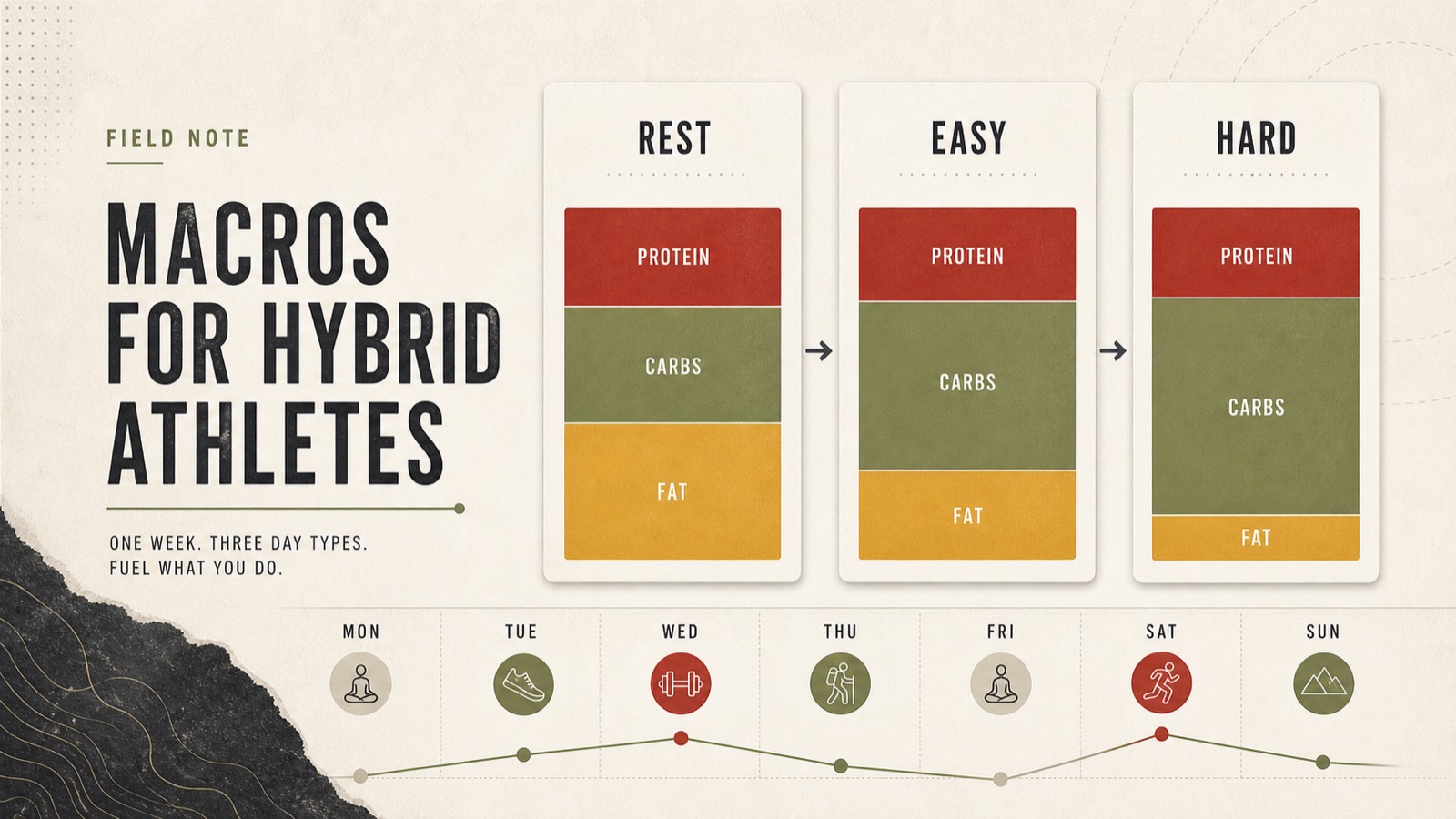
Most macro calculators assume every day is the same.
That is fine if your training is the same. It is less fine if Monday is lower body, Wednesday is intervals, Friday is a long run, and Saturday is a hike that accidentally turns into four hours outside.
Hybrid athletes do not have one kind of day. So it does not make much sense to eat like they do.
The goal is not to make nutrition more complicated. The goal is to stop pretending a rest day and a hard training day ask the same thing from you.
Start with the week
Your body does not reset at midnight because an app said your calories are over.
A better way to think about macros is weekly first, daily second.
If your goal is fat loss, maintenance, or gaining, the weekly calorie target is the big lever. The daily split is how you make that target fit your actual training.
That means you can eat a little less on rest days, a little more on hard days, and still land in the same weekly budget.
Nothing magical. Just better timing.
Protein stays boring
Protein is the anchor.
For most people who train, a reasonable starting range is about 1.4 to 2.0 grams per kilogram of body weight per day. That range is supported by the International Society of Sports Nutrition position stand on protein and exercise (Jäger et al., 2017), which recommends this range for exercising adults trying to support muscle repair and adaptation. Higher intakes (2.3-3.1 g/kg/day) may help preserve lean mass during energy restriction.
You do not need to reinvent protein every morning.
Hit a steady target. Spread it across meals if that helps. Build recipes around it. Then let carbs and fats do more of the daily adjusting.
Boring is good here. Boring works. A practical breakdown lives in How Much Protein Do You Really Need.
Carbs move with the work
Carbs are where hybrid athletes usually get themselves into trouble.
Not because carbs are special. Because training demand is not flat.
Hard running, lifting volume, intervals, long rides, hiking, snowboarding, and Hyrox-style sessions all pull from the same recovery account. The joint AND, DC, and ACSM position stand on Nutrition and Athletic Performance (Thomas, Erdman, & Burke, 2016) recommends periodizing carbohydrate intake by training demand: roughly 3-5 g/kg/day for low-volume or skill training, 5-7 g/kg for moderate-intensity training (about an hour per day), 6-10 g/kg for higher-volume endurance (1-3 hours per day at moderate to high intensity), and 8-12 g/kg for extreme volume (4-5+ hours). Hybrid weeks usually span multiple buckets across seven days.
So the practical rule is simple:
- Rest days get fewer carbs.
- Easy days get moderate carbs.
- Hard days get more carbs.
That does not mean you need a giant bowl of pasta because you touched a dumbbell. It means the hard day should not be the day you accidentally undereat and then wonder why tomorrow feels like dragging furniture uphill.
Fat fills the rest
Fat matters. Hormones, food satisfaction, flavor, and basic sanity all live here.
But if you are training hard and calories are fixed, fat usually should not crowd out the carbs you need to perform.
That is the tradeoff.
On lower training days, fat can sit a little higher. On hard days, carbs usually deserve more room. Not because fat is bad, but because hard training has a bill to pay.
The three-day system
This is the cleanest way I know to set macros for hybrid training:
- Rest day: lower calorie, steady protein, lower carb, moderate fat. Use this for full rest days, mobility days, or light walks.
- Easy day: moderate calorie, steady protein, moderate carb, moderate fat. Use this for easy runs, Zone 2, lighter lifts, yoga, or normal active days.
- Hard day: higher calorie, steady protein, higher carb, lower-to-moderate fat. Use this for long runs, intervals, heavy lifting, double sessions, race prep, big hikes, or any day where performance actually matters.
Same weekly plan. Better daily distribution.
The Hybrid Athlete Macro Calculator handles this distribution automatically: enter a weekly hard/easy/ rest split and it scales the macros for each day type while keeping the weekly total on target.
The trap: cutting too hard while training hard
Hybrid athletes are especially good at accidentally underfueling.
You add running to lifting. Then you add steps. Then you add a weekend activity. Then you try to cut calories like your only goal is sitting still and shrinking.
That can work for a week. Maybe two.
Eventually, the bill shows up: worse sessions, more cravings, poor sleep, lower motivation, and that flat feeling where every workout technically happens but none of it feels productive.
Low energy availability is a real concern in athletes when intake is too low relative to training demand, with documented effects on bone, endocrine, immune, and cardiovascular health (Mountjoy et al., 2018, the IOC consensus statement on relative energy deficiency in sport). You do not need to diagnose yourself from a blog post. But you should respect the pattern.
If performance keeps sliding, hunger is loud, sleep gets weird, and your plan requires white-knuckling every night, the answer might not be more discipline.
It might be more food in the right places.
Adjust from the trend
A calculator gives you a starting point. Your body gives you the edit.
Run the numbers. Follow them for two weeks. Track your body-weight trend, training performance, hunger, and recovery.
- If weight is moving too fast, add food.
- If weight is not moving and fat loss is the goal, remove a small amount.
- If performance is falling apart, look at hard-day carbs first.
- If adherence is falling apart, look at the whole plan.
The same Thomas et al. position stand makes this explicit: predictive equations are starting estimates, and athletes should adjust energy intake based on actual body-weight trend and training performance.
Macros are a measuring tape, not a religion.
The point
Hybrid nutrition is not about eating perfectly.
It is about matching the food to the work.
Protein keeps the structure steady. Carbs move with training demand. Fat fills the rest. Calories still decide the bigger direction, but the day-to-day layout should make your training feel possible.
You are not trying to win the spreadsheet.
You are trying to fuel the week you actually live.
Run your numbers with the Hybrid Athlete Macro Calculator and set separate targets for rest days, easy days, and hard days from one weekly calorie budget.
For information and education, not medical advice. If you have a health condition, are pregnant, or take medication that interacts with diet, talk to a clinician before making changes.
End of note
Subscribe
Get the next Field Note by email
A short email when a new article or recipe ships. No spam, no upsell, unsubscribe in one click.